%20White%202.png)


OASIS, LONDON, AND THE SOUND OF REVOLUTION: WHY ROCK ANDROLL ISN’T DEAD. IT’S JUST BEEN WAITING FOR A REASON TO ROAR

Written by; Jason Hollis
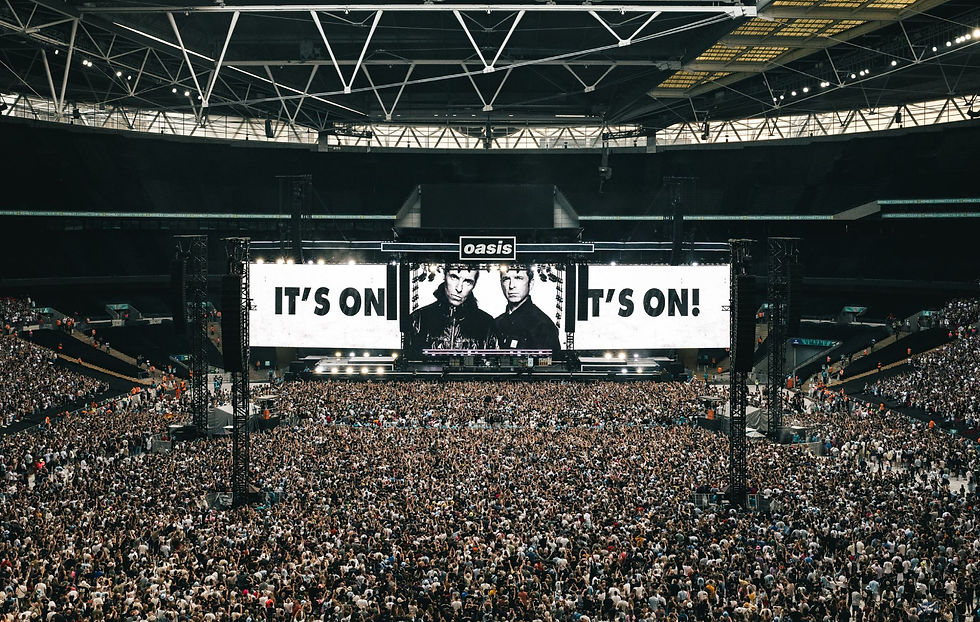
Wembley, London, July 25, 2025: Oasis, Night One
Ninety thousand people. One band. Zero cynicism. Wembley felt less like a concert and more like a Premier League final where the only team that mattered was Oasis, and the only rule was to lose your mind. The crowd? A sea of bucket hats, Adidas stripes, and nostalgia-soaked tears. For two hours, an entire country that has been told to keep calm, mask up, and stay miserable since COVID finally got a permission slip to lose the plot. Smiles, sobs, fists in the air, and every single voice screaming every single word. It was not a gig. It was a resurrection. If you were not there, you will never get it. If you were, you will never forget it. Wembley became a temple, and Oasis were the high priests leading the congregation, turning a stadium into a sanctuary for the faithful.
I saw grown men hugging strangers, women in Doc Martens dancing on seats, and one guy with a Union Jack cape openly weeping during “Don’t Look Back in Anger.” It was messy, it was beautiful, and it was the sound of a country remembering how to feel something together.

Rock and Roll: On Life Support, or Just Getting Started?
Let’s get honest. Rock and roll has been kicked, punched, and left for dead by streaming services, TikTok trends, and enough algorithmic nonsense to make even the most die-hard fans question their life choices. The industry’s answer to everything? Put it online, make it free, hope for the best. Spoiler. When you make art free, it loses value. Try telling that to anyone who has written a song, scraped together studio money, and then watched their masterpiece get lost in the digital landfill, sandwiched between a cat video and a toothpaste ad.
Here’s what really grinds my gears. The suits in glass towers who would not know a good song if it bit them on the ass, telling artists to go viral as if you can bottle lightning on command. When was the last time an algorithm made you feel alive? Exactly.
But here’s the thing. You cannot kill rock and roll. You can try to starve it, you can try to shame it, you can even try to algorithm it into submission, but it keeps crawling out of the grave, eyeliner smeared, middle finger raised. What I saw at Wembley was proof. For a few hours, the misery of the last five years melted away, and ninety thousand people remembered what it means to feel alive. No screen, no swipe, no skip button. Just sweat, sound, and the kind of joy you cannot fake. Music is not supposed to be background noise. It’s supposed to make you spill your drink, call your ex, and run out into the street screaming the chorus.

London: Still the World’s Capital of Cool (Sorry, Not Sorry)
London is a city that never lets you forget it invented cool. My trip was a blur of pubs, bands, and the kind of characters you wish you could bottle and bring home. The World’s End, where I met Sister, a brother-sister band with enough attitude to make the Gallagher brothers look like choirboys. The Hawley Arms on Camden High Street. Then there was The Marquis in Covent Garden, where Cam Muncey from Jet jumped on stage for an impromptu set and the place exploded. Rockstars packed the room. I drank Guinness with the band from Tempesst, Andy The Glam, and local legend Max Bianco. If you know, you know.
One night at The Marquis, I found myself wedged between a couple of off-duty roadies and a local fashion designer who claimed she could spot a tourist by their shoes alone. We argued about Bowie, swapped stories about the best gig we ever saw, and closed the place down with a round of warm gin and even warmer opinions.
But it was not just the pubs. I met Gary James McQueen, nephew of Alexander McQueen, at his London studio. His Skull Art was on display. More rock and roll than the Hall of Fame itself. The spirit of rebellion and creativity was everywhere.
Denmark Street still hums with possibility, even if the guitars are now worth more than your car. The Wembley Tavern, The White Horse, Camden Market. The list goes on. Each place a shrine, each pint a communion.
London is not just surviving, it is plotting a comeback. There is a rhythm in the air and swagger in the step of the working class. People are dressing the part again. Eye contact is back. Even the Tube feels like it is running on attitude instead of electricity. Rock and roll is not just alive here. It is lurking in every alley, waiting for its next victim. In London, cool is not a trend. It’s the air you breathe and the way you walk down the street.

Manchester: Where Ghosts and Guitars Collide
You cannot talk about British rock without a pilgrimage north. Manchester is still haunted by the echoes of its legends. The Salford Lads Club, Sifters Records, The Old Wellington. These are not just tourist stops, they are sacred ground. You feel the weight of every chord Oasis ever played, every lyric Morrissey ever moaned, every pint spilled in the name of something bigger than yourself. The city’s musical DNA runs through The Stone Roses, Joy Division, New Order, The Smiths, The Charlatans, and Happy Mondays. Manchester does not just make bands. It makes movements.
This time, I went even further off the map and found myself in the town of Hale, tucked away in the borough of Trafford. It is a neighborhood steeped in rock and roll royalty. Johnny Marr, Graham Coxon, and others left their fingerprints here. And then there is Jimmy Sweet, a legend in his own right. I caught his band, The Gospel, before heading back to London. The Gospel is a band that wears its darkness like a badge of honor. Their sound is soaked in the shadowy drama of Nick Cave, with lyrics that feel like confessions whispered in a cathedral after midnight. Onstage, they conjure a kind of haunted glamour, equal parts danger and devotion. Their new single promises to be a sermon for the sinners, and the crowd that night looked ready to follow them anywhere. It was the kind of night that reminds you why you chase live music in the first place.
And yet, it is not just about the past. There is hunger in the air, a sense that the next big thing could be tuning up in the back room right now. Manchester knows how to grieve its heroes, but it never stops looking for the next one. Manchester does not just remember its legends. It dares you to become one.

The Industry: How to Ruin a Good Thing in Ten Easy Steps
Let’s talk about the elephant in the room. Streaming services. Remember when music was dangerous, when you had to work for it, when you saved up for that one album and played it until the tape snapped? Now, everything is free, which is just another way of saying worthless. The amount of blood, sweat, and overdraft fees that go into making a record, only to see it tossed into the Spotify abyss for a fraction of a cent per play. It is criminal. And do not get me started on the playlist economy. If your band is not viral by Tuesday, good luck paying rent.
Venues are disappearing. The suits are winning. But every time someone declares rock dead, some band in a basement, some kid with a guitar, proves them wrong. The revolution is not just coming. It is tuning up backstage.
If you are an exec reading this, here is a hot tip. If your idea of disruption is another playlist, you might want to start looking for a new gig. The future belongs to the ones with dirty fingernails and nothing to lose. You can’t crowdsource a revolution. You have to kick down the door and make your own noise.

A Revolution in the Air: Oasis as Catalyst, Not Nostalgia
You could feel it at Wembley. This was not just a reunion show for the middle-aged and the nostalgic. This was a shot in the arm for a country that has been force-fed blandness and told to call it progress. Oasis did not just play the hits. They reminded everyone what rebellion sounds like. The crowd, kids, parents, old punks, and new dreamers, did not just sing along, they roared. For the first time in years, people made eye contact. Strangers hugged. You could smell the sweat and the hope. It was a reminder that rock and roll is supposed to be dangerous, not polite background noise for a TikTok recipe.
Here is the dirty secret no one in the music industry wants you to say out loud. The system is rigged against the very thing that made music matter in the first place. Venues are shuttered, artists are paid in crumbs, and every new band is told to be brand safe if they want a shot. Well, here is a fix. Stop being safe. Stop chasing algorithms and start chasing chaos. Let artists get loud, get weird, get political, get real. If the suits do not like it, maybe they should go back to selling insurance. Rock and roll is not made for playlists. It is made for riots.

Stats Don’t Lie: Where Did All the Bands Go?
Let’s talk numbers, because nothing kills a party like cold, hard facts. In the 1980s, over a hundred bands hit number one in the US. The nineties? Down to twenty-seven. The 2000s? Fourteen. Meanwhile, the UK saw a spike to over a hundred bands topping the charts in the 2000s. What happened in America? Did we get bored? Did we get lazy? Or did we just stop caring about bands and start worshipping at the altar of the influencer?
Here is a fix. Stop letting tech companies decide what is cool. Start letting the kids in the basement, the bands in the van, and the weirdos with guitars take over again. Give the power back to the people who actually make the music, not the ones who make the apps. If you want a revolution, don’t wait for permission. Build your own stage and plug in.
Has Technology Killed Cool?
Let’s get real. Spotify did not just change how we listen. It changed what we listen to. The algorithm is the new gatekeeper, and it does not give a damn about your band’s soul or your city’s scene. It cares about what gets clicks, what loops, what can be chopped up for a ten-second video. Cool used to be about risk, about sticking your neck out, about making people uncomfortable. Now it is about fitting in, going viral, and not getting canceled.
Here is what we do about it. Burn the algorithm to the ground. Start a label that does not care about playlists. Throw a party in a basement and do not tell anyone until the last minute. Make art that pisses people off. If your music is not making someone uncomfortable, you are doing it wrong. If your music does not scare your parents, you are playing it too safe.

The Third British Invasion? Don’t Call It a Comeback. Call It a Warning
There is a reason London feels electric right now. There is a reason Manchester still hums. It is because the UK never really gave up on the idea that a band can change the world. The US? We have spent the last decade chasing trends instead of chasing trouble. But you can feel it shifting. Oasis is not just back. They are lighting the fuse. The bubble is about to pop, and when it does, you had better be ready to get messy.
Here is my challenge to every American and Australian band reading this. Get your swagger back. Get loud. Get political. Get weird. The revolution is coming, and you do not want to be the last one to the party. History does not remember the safe bet. It remembers the ones who set the room on fire.

Final Rally Cry: Rock and Roll Is a Right, Not a Relic
So here is the truth. Rock and roll does not need your permission to come back. It just needs a spark. You can try to bury it under hashtags and streaming deals, but the moment a band like Oasis steps on stage and ninety thousand people lose their minds, the world remembers what rebellion sounds like. Rock and roll is a right of passage, not a relic for the museum. It is sweat, swagger, and the undeniable feeling that you are part of something bigger than yourself.
This trip to London was not just a vacation. It was a front row seat to the next revolution. I saw a city waking up, a country ready to ditch the grey and get loud again. I met artists, designers, and dreamers who are not waiting for permission. They are making their own rules, writing their own anthems, and dressing like every night could be the first night of the rest of their lives.
Maybe it is time we all took a cue from them. Maybe it is time to stop asking if rock and roll can survive, and start demanding that it does. Maybe, just maybe, it is time for the world to get loud, get weird, and get real again.
So here is my advice. Stop scrolling. Go to a gig. Buy a record. Start a band. Make some noise. If the suits and the algorithms do not like it, even better. Because the revolution is already here. If you want in, all you have to do is show up.
Turn it up and tear it down.


Comments